Conservation Burial Alliance
  • Home
  • Meet Us
    • Our Mission
    • Meet Our Founders
    • Board of Directors
    • Board of Directors Application
  • Conservation Burial
    • Find a Conservation Burial Ground
    • At a Glance
    • The Conservation Burial Experience
    • Working Together
    • Conservation Burial for Land Trusts
    • Conservation Burial Standards
    • Start Up Information
    • Questions About Memorial Forests
  • Find Resources
    • Glossary
    • Photo Gallery
    • Books, Videos, Articles
    • Presentation Resources
    • Family Stories
    • Burying Cremated Remains
    • Frequently Asked Questions
    • Guidelines for Special Circumstances
  • Events
    • Webinars
  • Become a Member
    • Become a Member
    • Meet Our Members
    • Member Spotlight - April Zee from Prairie Creek Conservation Cemetery
  • Reach Out
    • Contact Us
    • Newsletters
    • For the Media
    • Find Assistance

Burying Cremated Remains

How Do Cremated Remains Fit Into Conservation Burial Practice?

While conservation burial is by definition one-step, full-body burial directly into the earth, most natural burial cemeteries offer the right to bury cremated remains to serve those who are searching for a place of burial that is respectful, environmentally-responsible, affordable, and protected forever. (Learn more about accepted terminology.)

Learn More About the Cremation Process
​and Its Environmental Impact

Summary of Cremation Science Factoids
  • Cremation is an incomplete process, leaving 6 – 10+ lbs. of pulverized bone
  • Crematory retorts each burn fossil fuels (usually natural gas) a minimum of 2-3 hours between 1700° F and 1900° F
  • Mercury, nitrous oxide, and particulate matter is released into air and water despite improved scrubbers (British Columbia study 16%, Minnesota study 14%)
  • Risk of radiopharmaceutical contamination to crematory operators (Journal of the American Medical Association, 2.26.19)
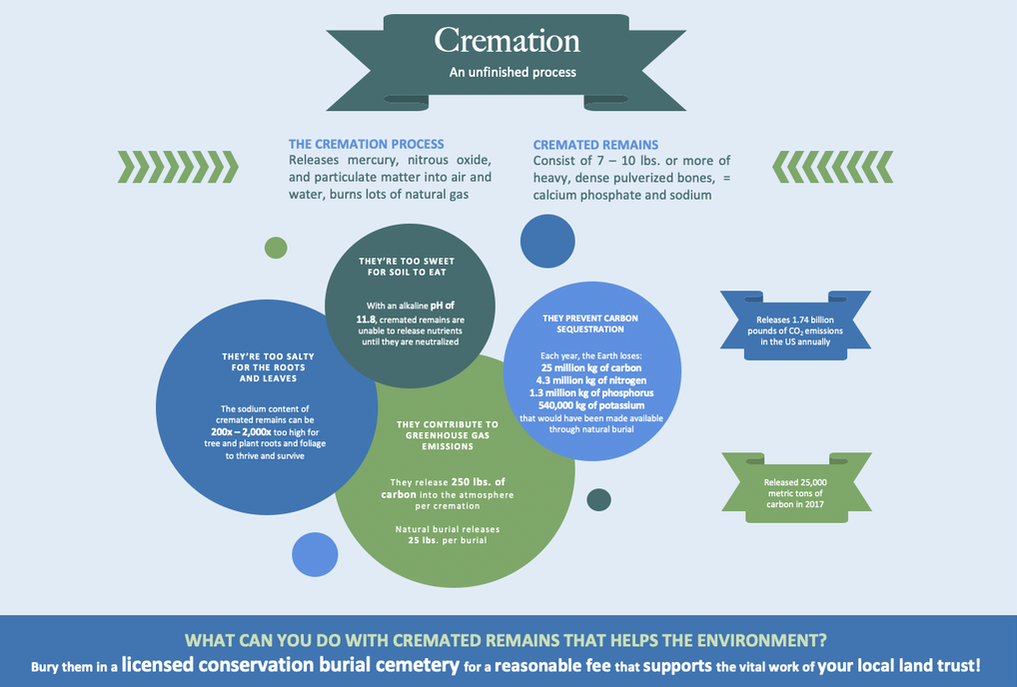
  • Cremation was responsible for releasing 25,000 metric tons of carbon in 2017
  • Average release is between 139 and 535 lbs. of carbon per person (as opposed to 25 lbs. of carbon sequestered for a green burial)
  • Final product = calcium phosphate and sodium (200 – 2000x too alkaline for what plants can tolerate) with an average pH of 11.8
  • Scattering can cause phosphorus run-off into nearby waterways, creating algae bloom that kills fish, plants, and other water life; girdling trees with them damages surrounding plant communities
— Compiled by Lee Webster, New Hampshire Funeral Resources, Education & Advocacy
Picture
For More In-Depth Information:
  • Watch Cremation Curious for a full explanation of cremation processes, including flame cremation, alkaline hydrolysis, and human composting
  • Read Carbon Benefits of Conservation Burial by Dr. Billy Campbell and lee Webster
  • Download The Potential Environmental Costs of Disposition

Facts About Burying Cremated Remains
​in a Conservation Burial Cemetery

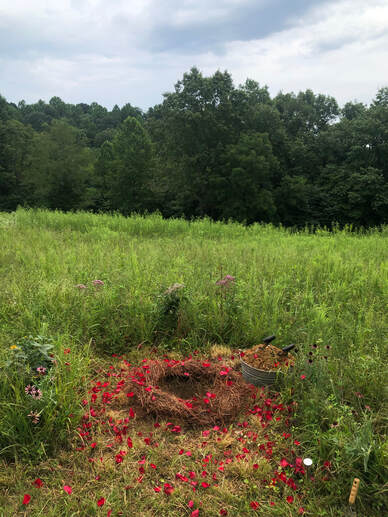
PictureCremation burial at Larkspur Conservation at Taylor Hollow, Nashville, TN
  • The costs of burying cremated remains in a conservation cemetery range from $650 to $4000.
  • Prices vary, depending on whether the burial includes only basic opening and closing fees (digging and filling the grave space) or additional services or fees, such as mapping/GPS and permanent grave locators, or cenotaph (memorial wall or other structure) engraving.
  • ​Costs will also likely include contributions to the perpetual care fund and land conservation fund.
  • Conservation burial cemeteries are registered with their states as cemeteries, guaranteeing their protection in perpetuity.
  • Conservation land trusts or other registered land protection agencies and entities are also involved with our cemeteries, adding another layer of protection through active property monitoring, and ensuring that the cemetery will be there undisturbed forever.
  • Conservation burial grounds follow well-established standards that  implement conservation plans that provide guidance for tree and foliage planting, restoring the land, and maintaining the cemetery and associated protected lands. Memorial plantings meet the plan's requirements.
  • Because cremated remains have a high sodium content and pH level, they can be detrimental to trees and plants both above and below ground. In addition, scattering them can cause phosphorus run-off into nearby waterways, creating algae bloom that kills fish, plants, and other water life. Some conservation burial grounds choose to bury cremated remains with proven soil amendments and a process design to protect roots and vegetation - protocols vary depending on location and soil and surrounding fauna conditions.
  • Some cremation burial or scattering businesses have adopted cremation burial best practices. Be sure to ask questions before committing to purchase. (Find questions here.) 
Picture
— Compiled and designed by Lee Webster, New Hampshire Funeral Resources, Education & Advocacy
Man shapes himself through decisions that shape his environment."
​— Rene Dubos

About the CBA

Meet Our Founders
Our Mission
Family Stories

For Land Trusts

Conservation Burial
Standards
​Cremation Burial
Working Together
Find Resources
Definitions
​Photo Gallery
Books, Videos, Articles
Presentation Resources
FAQ
​
​Start Up Tips

Make Connections

Become a Member
​Newsletters
​Find Assistance​
​
For the Media
​Join a Webinar
Picture
Contact Us​
[email protected]
Attn: CBA
4100 Starkey Blvd
Trinity FL 34655

Picture
Donate
Become a Member
Picture
Website design and content contributions by Lee Webster, SideEffects Publishing
  • Home
  • Meet Us
    • Our Mission
    • Meet Our Founders
    • Board of Directors
    • Board of Directors Application
  • Conservation Burial
    • Find a Conservation Burial Ground
    • At a Glance
    • The Conservation Burial Experience
    • Working Together
    • Conservation Burial for Land Trusts
    • Conservation Burial Standards
    • Start Up Information
    • Questions About Memorial Forests
  • Find Resources
    • Glossary
    • Photo Gallery
    • Books, Videos, Articles
    • Presentation Resources
    • Family Stories
    • Burying Cremated Remains
    • Frequently Asked Questions
    • Guidelines for Special Circumstances
  • Events
    • Webinars
  • Become a Member
    • Become a Member
    • Meet Our Members
    • Member Spotlight - April Zee from Prairie Creek Conservation Cemetery
  • Reach Out
    • Contact Us
    • Newsletters
    • For the Media
    • Find Assistance